Chapter 2. The World as a Graph: the anatomy of a non-material network
The idea
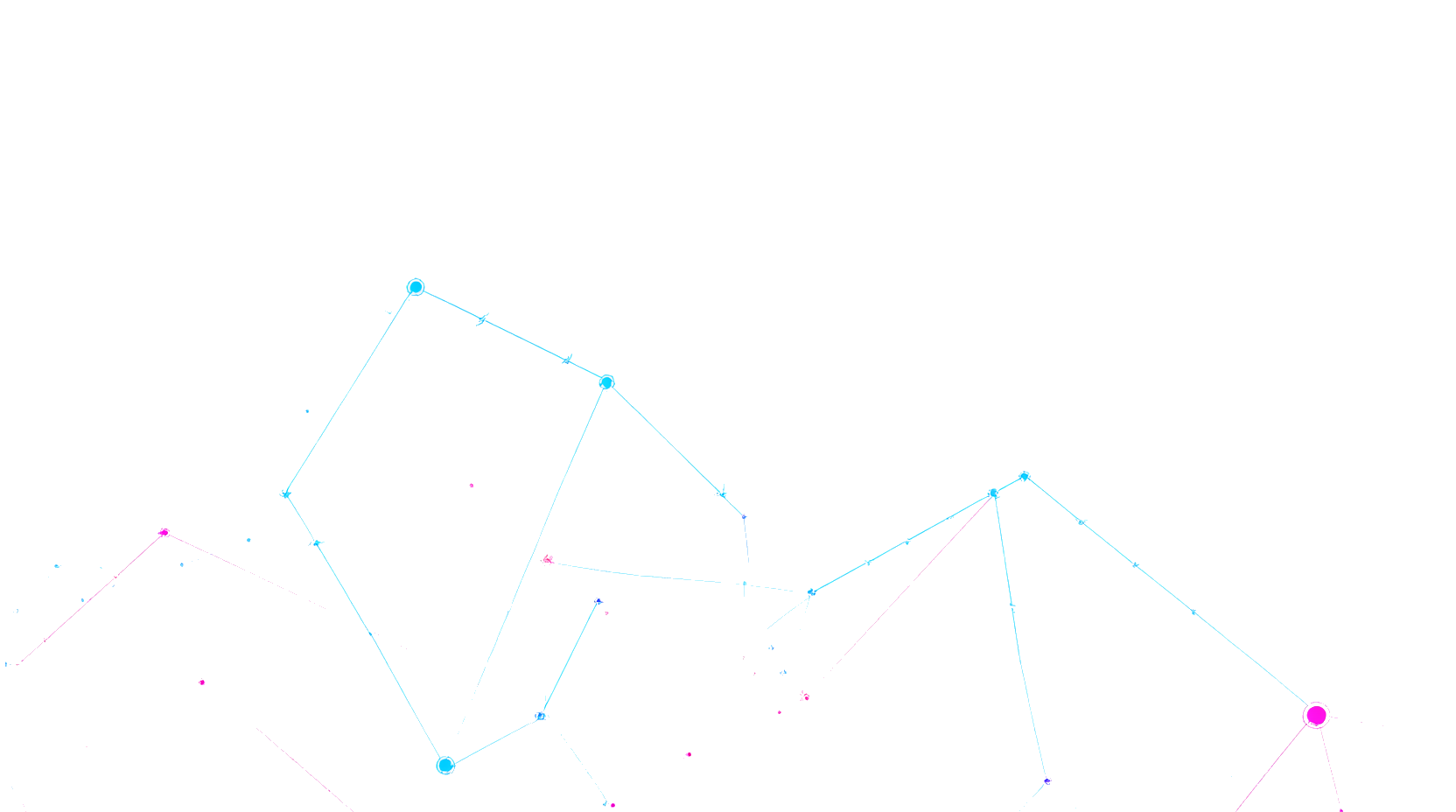
If there is no matter and no space as a “box”, then what does exist? The Theory of the Combinatorial Gap answers: a static, discrete graph of relations. The Universe is a network of connections, where objects have no isolated properties of their own and are merely nodes where those connections intersect.
The graph is discrete: there are no continuous trajectories, no smooth curves, no “velocities”. There are only fixed steps, nodes, and edges. Each edge is an elementary act of logical distinction — one binary relation. Space does not precede objects — it emerges from them. The closeness of two nodes is determined not by metric distance but by the number of edges between them.
The graph is static: it is a Block Universe in its pure form. No “flow of time”, no sequential “unfolding”. The entire graph exists wholly and at once, as a single combinatorial crystal. The illusion of time arises from the directedness of certain edges along which information is forced to move, with no possibility of turning back.
The edges of the graph come in two fundamental types:
-
Spatial edges — symmetric, bidirectional. They connect nodes without arrows: if A is connected to B, then B is connected to A. This is the fabric of volume, the geometry of “left–right”, “up–down”.
-
Temporal edges — asymmetric, directed. The arrow runs strictly from cause to effect. Information can move along them in one direction only. They are what create the illusion of the flow of time and irreversibility.
This structure finds direct parallels in modern physics:
-
Loop quantum gravity (Lee Smolin, Carlo Rovelli). Spacetime at the Planck scale is described as a discrete network (spin foam, spin network). There is no continuous manifold — only nodes and edges carrying quantum numbers. Area and volume are quantized.
-
Causal sets (Rafael Sorkin). An alternative approach to quantum gravity in which spacetime is modeled as a partially ordered set of discrete events. The order of causality (what comes before, what comes after) is not a continuous flow but discrete relations between elements.
-
The holographic principle ('t Hooft, Susskind, Maldacena). The three-dimensional volume of space can be fully described by information written on its two-dimensional boundary. This means that “volume” is an emergent property of a network of connections, not a fundamental entity.
-
Quantum entanglement as the “glue” of space. The work of Mark Van Raamsdonk (2010) showed that if you “cut” the entanglement between parts of a holographic system, space literally falls apart into disconnected pieces. Space is woven from entanglement — from relations.
Metaphors and examples
A social network. On Facebook there is no physical distance between users. “Closeness” is determined by the intensity of interaction. Space emerges from connections, not the other way around. No connections — no distance. The Universe works the same way: no graph — no space.
The filmstrip of the Block Universe. Imagine a film on which the entire movie is recorded. All frames exist simultaneously. Frame #5 does not “turn into” frame #6. No frame moves. But within each frame there is information about the “previous” one — and this creates the illusion of flow for the character inside the frame. The same is true of the graph: temporal arrows create the illusion of flow for the local pattern (consciousness) that “reads” the edges in one direction.
The crystal lattice. Diamond is not a “substance” but the geometry of bonds between carbon atoms. Remove the bonds — and there is no diamond, even though the carbon atoms “remained”. In the graph model of the Universe, bonds are primary, and “atoms” are merely points of their intersection.
Key takeaways
- The Universe is a static, discrete graph of relations. No continuity, no velocities.
- Space does not precede objects — it emerges from the network of connections.
- Edges come in two types: spatial (symmetric) and temporal (asymmetric, directed).
- Block Universe: the entire graph exists wholly and at once. Time is an illusion of the direction of temporal edges.
- The discreteness of the graph is consistent with loop quantum gravity and causal sets.
- The holographic principle confirms: volume is an emergent property of connections, not a foundation.