Chapter 4. The Combinatorial Gap: why the Universe did not collapse instantly
The idea
The central question of any model built on the decay of the Zero: if 0 = 1 + (−1), why did the resulting opposites not annihilate back into Zero in the very first instant? Why does a huge, complex world exist, rather than an instantaneous flash and silence?
The Theory of the Combinatorial Gap answers: because the Entangler is blind at short distances.
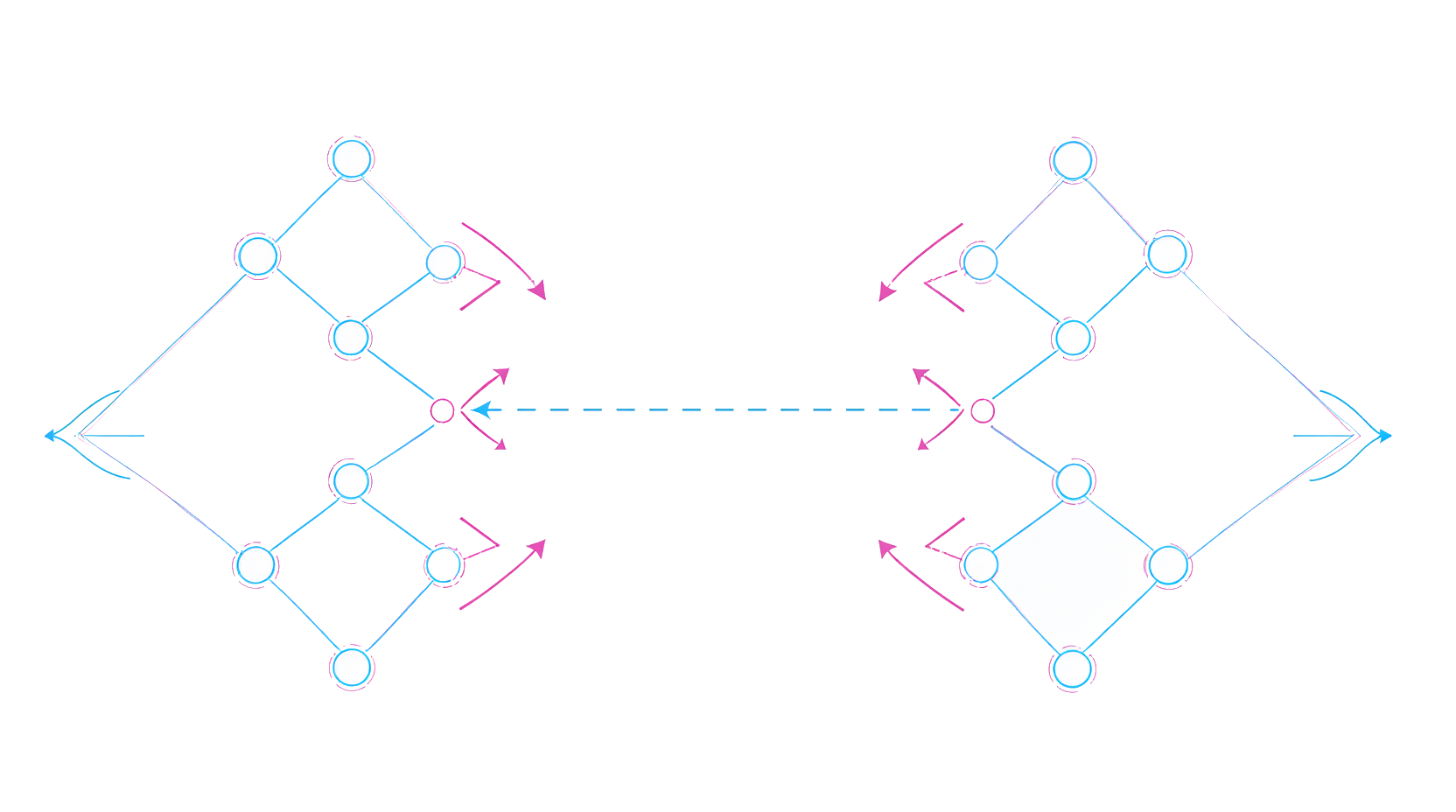
At the moment of the Zero’s primary decay, the resulting opposites (+1 and −1) turned out to be topologically too close to each other — at a distance of less than n edges. Because of its strict combinatorial rules, the Entangler could not “see” them. Its function is triggered only for groups of nodes separated by a distance ≥ n. At the initial moment, the graph consisted of just a few nodes — no group was large enough, and no distance exceeded the threshold.
A pause arose. A gap. And into this gap the Splitter poured.
Working locally, without conditions or restrictions, it avalanche-like split every node into tetrahedra, spawning new spatial and temporal edges. The defects of the graph (bubbles of asymmetry) were carried apart in different directions at the speed of combinatorial enumeration. The graph inflated. The distance between the original opposites grew.
The system has to run through trillions of iterations of enumeration in order to inflate the graph to the scales at which the Entangler can finally switch on. The entire “life” of the Universe — from the Big Bang to heat death — is precisely this combinatorial gap: the pause between the birth of asymmetry and the moment it finally falls into the sights of global merging.
Physical correspondences:
-
Cosmic inflation. In standard cosmology, inflation is a period of exponential expansion of space in the first 10⁻³² of a second. In our model, inflation is not a “special physical field” but a natural consequence of the fact that the Splitter works without restrictions while the Entangler has not yet switched on. The expansion is not “matter flying apart into the void” but the combinatorial growth of the number of graph nodes.
-
The baryon asymmetry of the Universe. In the first moments after the Big Bang, matter and antimatter should have annihilated completely. But this did not happen: for every billion particle–antiparticle pairs, one “extra” particle remained. In our model this is explained combinatorially: the Entangler could not annihilate what was too close and too small a group. The surplus of asymmetry is an “unfinished defect” of the initial phase.
-
The cosmic microwave background (CMB). The photons of the CMB are the “traces” of an early stage when the graph was still small enough and the Entangler had only just begun to work. The homogeneity of the CMB, accurate to within 10⁻⁵, is evidence that at the scale of the entire observable Universe, the combinatorial patterns are practically identical: the self-similarity of the graph in action.
-
The horizon problem. In standard cosmology, distant regions of the Universe could not have exchanged information during its lifetime, yet they have the same temperature. In the graph model this is not a paradox: the spatial edges of the graph do not obey metric “distance” in the usual sense. Two nodes may be “close” in the graph (few edges between them), even if in the projection onto 3D space they appear to be separated by billions of light years.
Metaphors and examples
A game of pursuit. Imagine a predator (the Entangler) that can catch its prey only at arm’s length, but no closer. And the prey (the Splitter) instantly clones itself and scatters in all directions. The predator cannot catch what is right under its nose — only what has already scattered. As long as the prey clones itself faster than the predator can reach the scattered copies, the system lives.
Epidemic and quarantine. The Splitter is a virus that infects only its neighbors (1 edge). The Entangler is a quarantine imposed only on whole cities (groups of nodes), and only if the city lies at a certain distance from the epicenter. While the virus spreads from one person to another, no quarantine is declared. The city grows — the quarantine is imposed.
A delayed explosion. A bomb with a timer. The decay of the Zero is the press of a button. But the timer (the parameter n) is set to a colossal number of ticks. While the timer ticks (the combinatorial enumeration of variants), the graph lives. When the timer reaches zero — the explosion (the return to zero). The entire Universe is the ticking of a timer.
Key takeaways
- The Combinatorial Gap is the pause between the decay of the Zero and the switching-on of the Entangler.
- The reason for the gap: the opposites were born at a distance of less than n edges, and the Entangler is “blind” to them.
- The Splitter uses the gap for the avalanche-like growth of the graph.
- The entire “life” of the Universe is a combinatorial race: the inflation of the graph up to the scale at which the Entangler switches on.
- Cosmic inflation is a natural consequence of the locality of the Splitter.
- The baryon asymmetry is a combinatorial “unfinished defect” of the initial phase.
- The horizon problem is solved: closeness in the graph ≠ metric distance in the projection.