Chapter 5. Matter, time, and the defects of the crystal
The idea
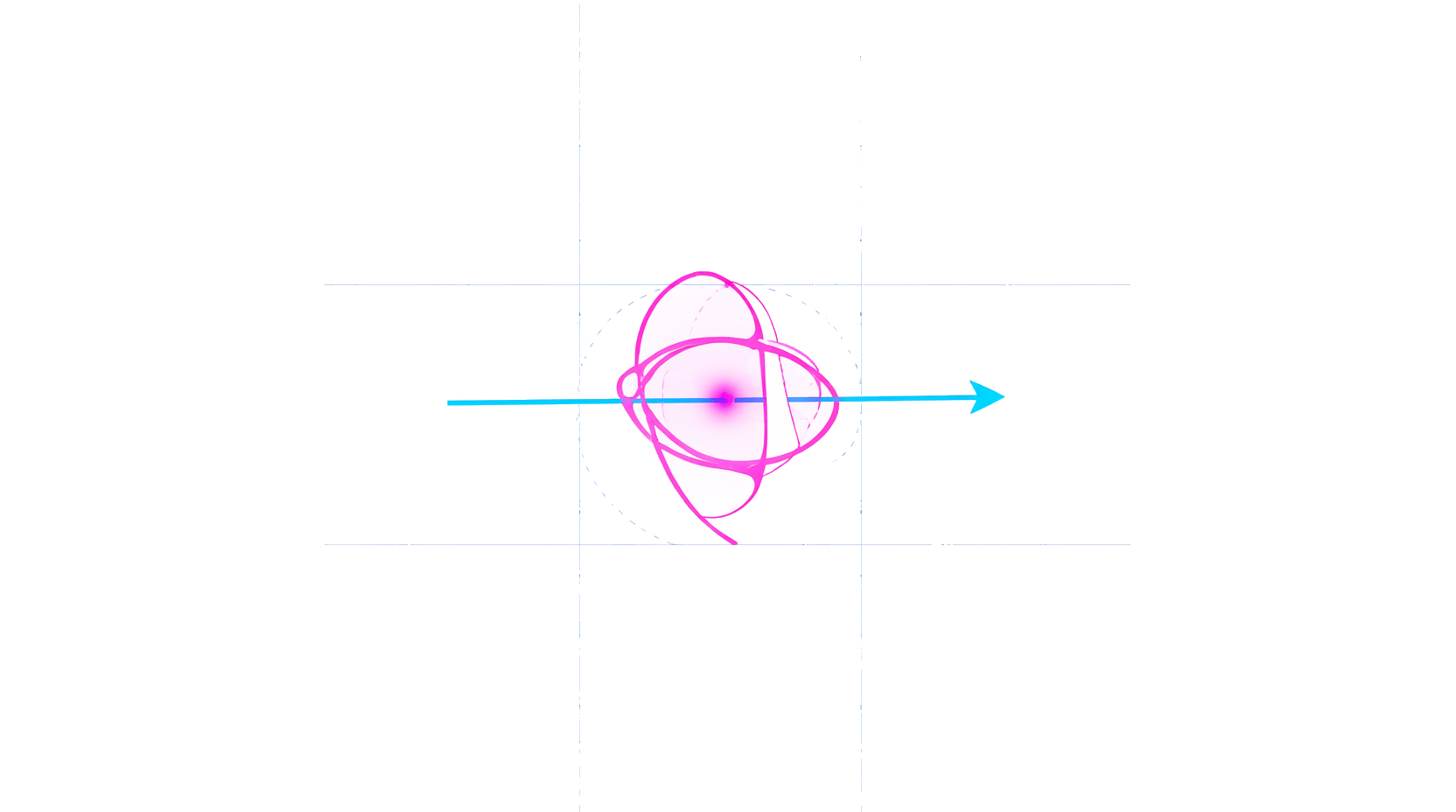
What do we call “matter” if there is no substance? In the Theory of the Combinatorial Gap, elementary particles and charges are topological defects (“twists” of the graph) in which the local asymmetry of connections is trapped. An electron, a quark, a photon are not “balls” and not “excitations of fields” in the usual sense. They are nodes — or dense clusters of nodes — at which the balance of incoming temporal and spatial connections is broken.
The conservation laws (of charge, energy, momentum) are not external “laws of nature” but rules of the combinatorial admissibility of the matrix. They forbid a defect from vanishing into thin air: a topological twist cannot unravel locally, without meeting its mirror opposite. The defect is forced to “travel” along the temporal arrows of the graph, being passed from one group of nodes to another. This is what we perceive as the motion of a particle.
Time. In the Block Universe there is no time as a continuous flow. The world is a static combinatorial crystal. The illusion of time arises from the strict directedness of the graph’s temporal edges, along which information (and our consciousness as a local pattern) is forced to move without the possibility of stepping backward. We do not “fly through time” — we are a static pattern that contains within itself a record of the “previous” node. That record is what creates the sensation of “flow”.
Consciousness in this model is not an entity, not a “soul”, not a computational process. It is a local pattern of the graph. Less interesting than the architecture of the crystal itself, but functional: the pattern “reads” the temporal edges in one direction and interprets this as a sequence of moments.
Physical correspondences:
-
Topological defects in condensed matter. Solid-state physics has real topological defects: dislocations, disclinations, Abrikosov vortices in superconductors. They cannot be eliminated locally — only by meeting an antidefect. Mathematically this is fully analogous to our “bubbles of asymmetry”.
-
The no-hair theorem (black holes). A black hole has only three external parameters: mass, charge, and angular momentum. All other information about the structure of the absorbed matter is “locked” inside. In the graph model this means that a defect which enters a zone of extreme packing loses its individual topology for an external observer — but combinatorially the information is preserved on the boundary (the holographic principle).
-
Quantum entanglement and nonlocality. Entangled particles correlate instantly regardless of distance. In the graph model this is not a “superluminal influence” but a direct spatial edge (a chord) laid by the Entangler between two nodes. In the metric of the graph they are 1 edge apart, even if in the projection onto 3D space there are billions of light years between them.
-
The arrow of time and entropy. The second law of thermodynamics (entropy never decreases) is a direct consequence of the directedness of temporal edges. The Splitter generates asymmetric arrows; the Entangler gradually cancels them. But as long as the Splitter outpaces the Entangler, the number of uncancelled arrows grows — and we call this “the growth of entropy”.
Metaphors and examples
A knot in a rope. Imagine an infinite rope (the graph). Tie a knot in it (a defect). The knot cannot vanish on its own — it cannot be “untied” without cutting the rope. It can only slide along the rope (move along the temporal arrows). And it can disappear only by meeting an anti-knot (a mirror twist), where the two unravel each other. This is an electron “flying” through space.
A pattern on wallpaper. Imagine infinite wallpaper with a regular pattern (a smooth graph). In one place the pattern is broken — the flowers are rotated, the lines bent (a defect). This break cannot “heal” on its own. It is fixed by the topology of the pattern. But if somewhere there is a mirror-broken pattern, bringing the two together restores the design.
Film without a projector. The Block Universe is a film lying in a box. All frames exist at once. There is no projector, no beam of light, no “flow”. But inside each frame an arrow is drawn, pointing to the next frame. The character inside the frame sees the arrow and thinks: “I am moving through time”. In fact he is simply drawn into a frame that contains an arrow.
Key takeaways
- Matter is topological defects of the graph in which the local asymmetry of connections is trapped.
- Conservation laws are rules of combinatorial admissibility of the matrix, forbidding a defect from vanishing locally.
- Defects “travel” along temporal arrows — this is what we perceive as the motion of particles.
- Time is an illusion of the directedness of temporal edges. No continuous flow exists.
- Consciousness is a local pattern of the graph that “reads” temporal edges in one direction.
- Quantum nonlocality is a direct spatial edge (a chord) in the graph, not a “superluminal influence”.