Chapter 7. The Finale: vanishing like fog
The idea
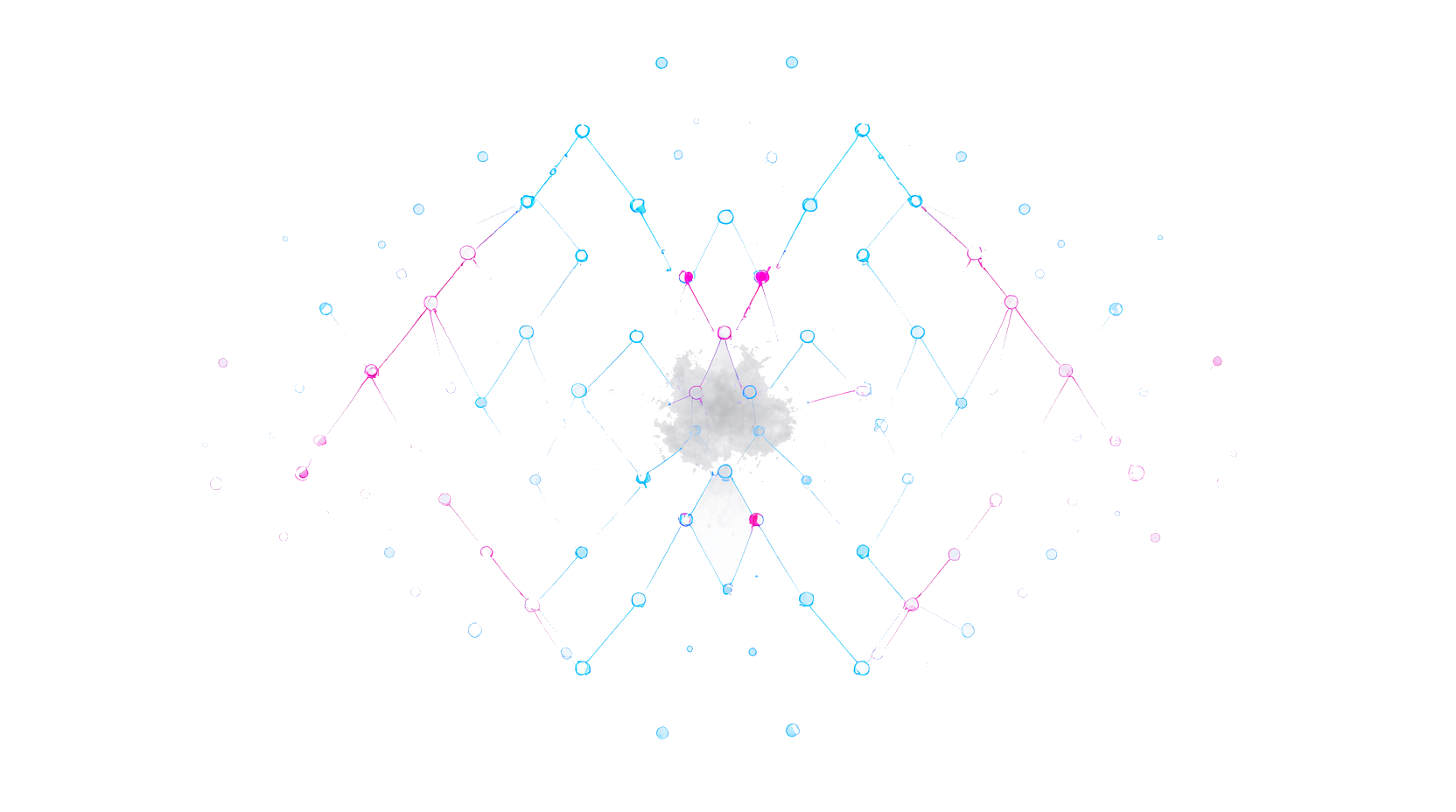
The end of the Universe in the Theory of the Combinatorial Gap is not a “Big Crunch”, not a “Big Rip”, and not eternal cooling. It is the combinatorial exhaustion of the enumeration of variants, followed by total group entanglement and the instant dissolution of the graph into a homogeneous final Zero.
The mechanics of the finale:
-
The exhaustion of splitting. The matrix of discrete variants is finite for a given combinatorial set. Working locally, the Splitter sooner or later fills all admissible topological configurations. There are no more new unique tetrahedra to insert. The growth function stops.
-
The squeezing-out of the bubbles of asymmetry. The remaining defects (bubbles of asymmetry) find themselves squeezed out to the critical distance of n edges. This happens because the combinatorial enumeration inevitably carries them to the maximal topological distances — the graph simply has no “room” left for close, unstitched defects.
-
Total group entanglement. The Entangler, finally having full access to all the clusters (all of them at a distance ≥ n and of sufficient size), switches on globally. The symmetric connections outweigh the temporal arrows, canceling their direction. Differences are erased.
-
Dissolution into fog. The graph instantly loses its entire structure. There are no more nodes, edges, arrows, or defects. There is only a homogeneous, indistinguishable medium — the final Zero. The Universe does not explode, does not contract, does not cool down. It vanishes like fog, when the sun floods everything with even light and the drops of water cease to be distinguishable.
Physical correspondences:
-
The heat death of the Universe. In standard cosmology, heat death is a state of maximum entropy in which all temperature gradients vanish and no processes are possible anymore. In the graph model, heat death is the moment when all temporal arrows have been canceled by the Entangler and the graph becomes fully symmetric. No gradients — no relations — no Universe.
-
Penrose’s conformal cyclic cosmology. Roger Penrose showed that at the end of time, when all matter decays into massless photons, the Universe loses the notion of scale. For a massless photon there is no proper time, and space contracts to a point. A vast, empty Universe becomes mathematically indistinguishable from the singularity of the Big Bang. In the graph model: when all the defects are canceled and only spatial edges remain, with no temporal arrows, the graph loses its scale structure and collapses into a single point.
-
The de Sitter Universe. In the far future, when dark energy dominates, the Universe approaches de Sitter space — a purely exponentially expanding vacuum. The density of matter and radiation falls to zero. In the graph model: this is a state in which the defects are completely isolated from each other by the cosmological horizon. Each defect is locked in its own “bubble”. The graph breaks up into disconnected components. The connections between them are canceled. The final Zero.
-
The dissolution of photons in the vacuum. A lone photon in an expanding de Sitter vacuum interacts with quantum fluctuations (the Unruh–Dewitt effect). Its energy falls, its wavelength stretches, and in the limit it loses its individuality, dissolving into the background noise of the vacuum. In the graph model: the last defect (a photon) loses its asymmetry, becoming indistinguishable from the homogeneous background. The boundary between “object” and “medium” is erased. The graph returns to zero.
-
The loss of the vacuum’s memory. The final vacuum does not “remember” the previous Universe. There are no hidden markers, no subtle asymmetries, no “seeds” for the next cycle in the sense of information transfer. The Zero is absolutely pure. This follows from the fact that maximal entropy is the complete erasure of correlations. Memory is structure, and structure is asymmetry. No asymmetry — no memory.
Metaphors and examples
Morning fog. At night, fog is distinct drops of water, each with its own shape, size, and trajectory. This is a graph with defects. In the morning the sun (the Entangler) floods everything with even light. The drops evaporate; the boundaries between them are erased. An hour later you could not say where any given drop had been. The fog has vanished. It did not explode, did not contract — it simply ceased to be distinguishable.
An overcrowded hall. Imagine a hall where people (defects) dance in pairs. While the hall is half full, the pairs move freely, not touching one another. But when the hall fills to its limit, everyone is pressed against everyone. Movement becomes impossible. The boundaries between the pairs are erased. The hall turns into a single motionless mass. Then the light goes out — and there is no hall anymore.
The erasing of a drawing. Draw a pattern on glass with a marker (a graph with defects). Now breathe on the glass (the Entangler). The steam covers the whole surface, blurring the lines. The pattern disappears not because it was “wiped away” mechanically, but because the contrast between the lines and the background has vanished. Everything has become the same. Zero.
Key takeaways
- The Universe’s finale is the combinatorial exhaustion of variants, not physical destruction.
- All bubbles of asymmetry are squeezed out to a distance ≥ n, where the Entangler cancels them.
- Temporal arrows are short-circuited. The arrow of time disappears.
- The graph dissolves into the homogeneous Zero instantly, “like fog”.
- The final vacuum does not remember the previous Universe. Memory is asymmetry; the Zero has none.
- Penrose’s model (the loss of scale by massless photons) is a direct confirmation of the return-to-zero mechanism.