Chapter 8. The Isomorphic Cycle and the Multiverse of sets
The idea
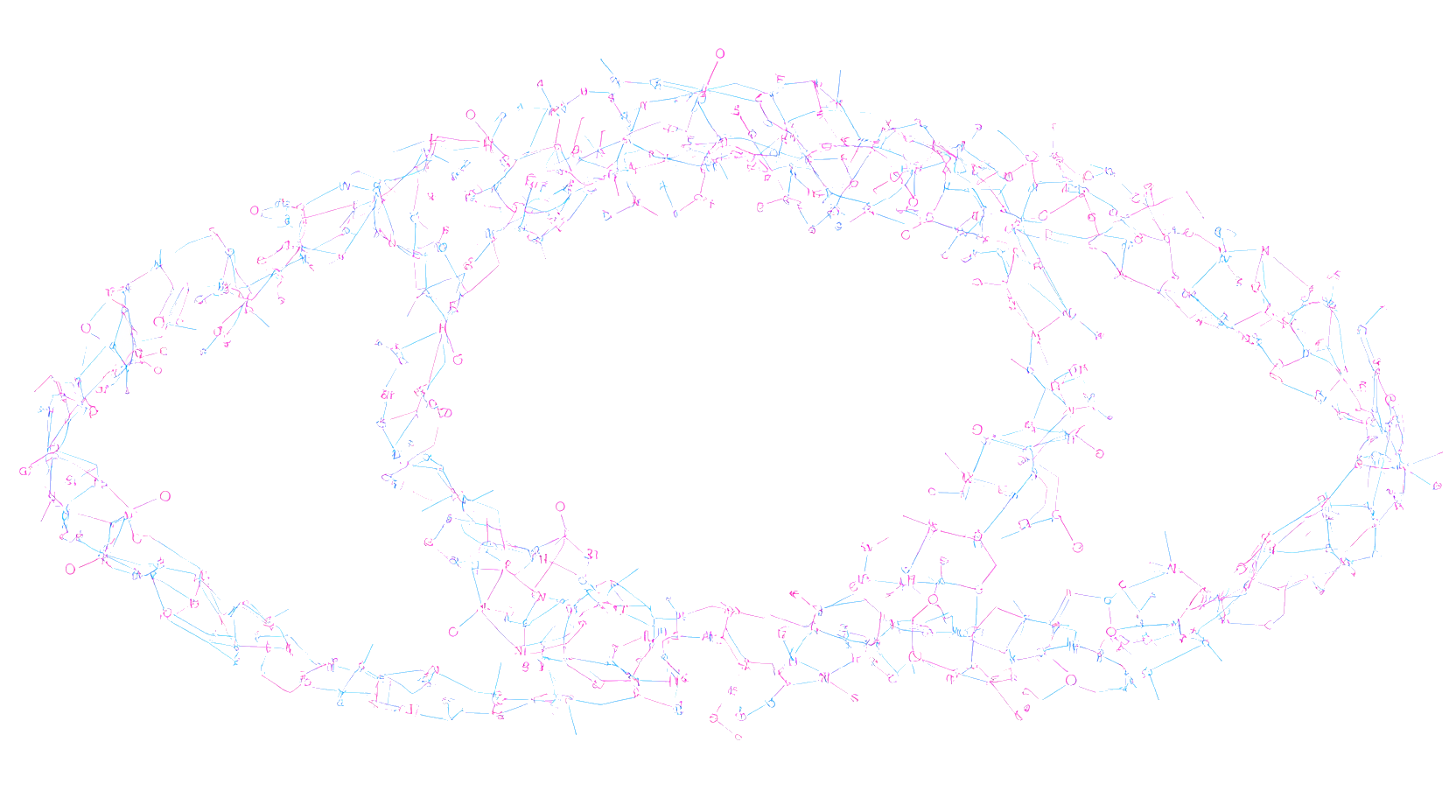
The end of the graph is mathematically identical to its beginning. The final Zero, in which the entire structure dissolved, is logically indistinguishable from the original Zero from which the graph was once born. This closes the Universe into a topological loop — a torus or a fractal, where the beginning and the end are glued together.
But in the Block Universe, where there is no time, a “cycle” does not mean “repetition in time”. Cycles do not follow one another. They exist simultaneously, merging into a single eternal isomorphic crystal.
Self-similarity and isomorphism. Every new “cycle” unfolds into strictly self-similar, equivalent structures that are topologically indistinguishable from a copy. In graph theory, two graphs built by the same rules and having the same network of connections are called isomorphic. If two graphs are isomorphic, it is impossible to find a single structural difference between them. For mathematics itself, they are the same object.
This means that “copies” of the Universe with a given combinatorial set do not exist. There is only one single graph. All “cycles”, all “attempts”, all “repetitions” are the same object seen from different sides. In information space there is no place where two identical graphs could lie in parallel, for “place” is defined by the connections themselves.
The Multiverse of sets. Since being is free and requires no substrate, an infinite number of other universes with completely different combinatorial sets of rules and space dimensions unfold simultaneously from the original Absolute Nothingness.
- In one universe, the Splitter produces not tetrahedra, but five-dimensional or infinite-dimensional cells.
- In another universe, the parameter n equals zero, and everything collapses instantly — these are “stillborn” flash-worlds.
- In a third, the temporal edges are bidirectional, and there is no arrow of time.
- In a fourth, the Entangler works locally and the Splitter globally, and the dynamics are completely inverted.
All these worlds do not compete for space and do not follow one another. They exist simultaneously as different mathematical solutions in the space of pure logic. Like geometric figures — a circle, a triangle, a torus — which exist eternally and unchangingly, needing no material embodiment.
Physical correspondences:
-
The string theory landscape. The mathematics of string theory allows for about 10⁵⁰⁰ variants of compactification of extra dimensions. Each variant is a separate Universe with its own laws of physics. In the graph model, each such variant is a separate combinatorial set of rules for the Splitter and the Entangler.
-
The Ten-Fold Way. The classification of topological phases of matter by Cartan symmetric spaces divides all possible quantum systems into 10 fundamental classes. This is a real “atlas” of possible combinatorial sets — not for matter, but for the very structure of relations. Each class is a potential universe with a certain type of symmetry breaking.
-
Penrose’s conformal cyclic cosmology (CCC). In Penrose’s model, the end of one universe (aeon) becomes the beginning of the next. But in the graph model, this is not a sequence in time, but a topological gluing: the final node of the graph is identical to the initial one. There is no “next” cycle — there is one closed graph.
-
Lee Smolin’s cosmological natural selection. Smolin suggested that universes that produce more black holes “reproduce” more successfully, passing their parameters through singularities. In the graph model, this can be reinterpreted: combinatorial sets in which the Entangler triggers more often (more black holes = more local zeros) produce more complex and stable graphs. But this is not evolution in time — it is a property of the combinatorial set itself.
-
Everett’s Multiverse. In the standard interpretation of Everett, all alternative outcomes of quantum measurements are realized in “parallel universes”. In the graph model, all branches exist simultaneously as different directions of edges in one block graph. There are no “parallel” universes — there is one universe with all branches at once.
Metaphors and examples
Geometric figures. A circle, a square, and a triangle do not “follow” one another. They do not compete for space on a piece of paper. They simply exist as mathematical possibilities. The same is true of universes with different combinatorial sets: they do not fight for reality. They simply are — like theorems in the space of pure logic.
An orchestra and scores. Imagine an infinite library of musical scores. Each score is a combinatorial set. Our Universe is one score, closed in a ring (the finale is identical to the beginning). Another score is a piece for five instruments instead of four (a five-dimensional Splitter). A third is a piece that breaks off on the first note (n = 0). All scores lie on the shelves simultaneously. None is “played” — they simply exist as pure structures.
The Mandelbrot fractal. A fractal is infinitely self-similar: any fragment of it, when enlarged, repeats the whole. But a fractal does not “grow in time”. It exists wholly and at once as a mathematical object. The isomorphic cycle of the Universe is the same: it is not a process, but a structure. Not “repetition”, but self-similarity. Not “next time”, but “always simultaneously”.
Key takeaways
- The end of the graph is mathematically identical to its beginning. The Universe is closed in a topological loop.
- Cycles do not follow one another in time — they exist simultaneously as one isomorphic crystal.
- All “copies” with one combinatorial set are topologically indistinguishable and merge into one object.
- The Multiverse is an infinite set of graphs with different combinatorial sets, existing simultaneously.
- The string theory landscape (10⁵⁰⁰ variants) is a physical confirmation of the multiplicity of combinatorial sets.
- Cartan’s Ten-Fold Way is a real “atlas” of possible types of symmetry breaking.
- Being is free: no universe requires a substrate for its existence.