Chapter 3. Two Operators: the Splitter and the Entangler
The idea
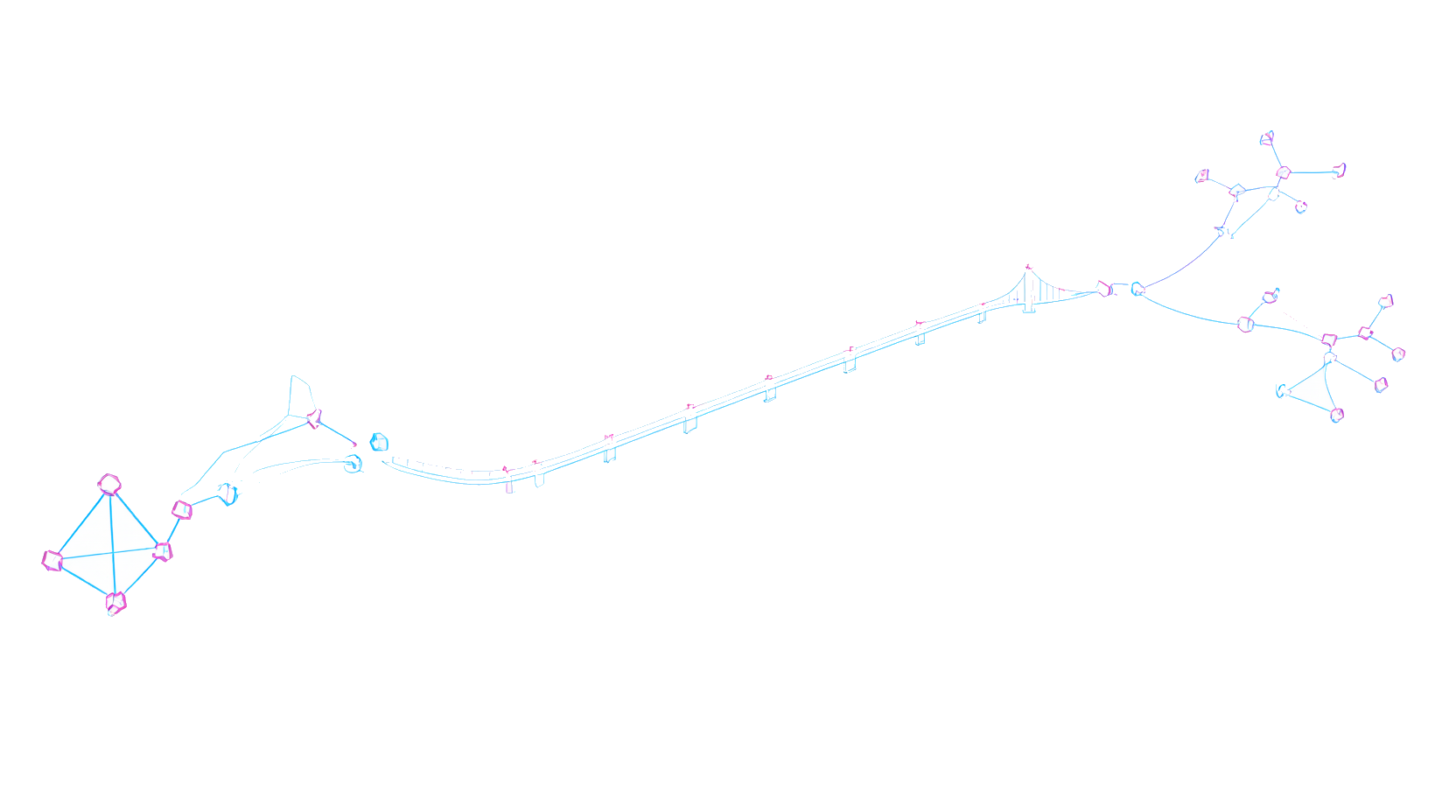
All the combinatorics of the Universe’s graph is governed by the asymmetry of two basic operators. These are not “forces” in the Newtonian sense, nor “fields” in Maxwell’s sense. They are graph-rewriting rules — two functions that determine how the matrix of combinations evolves from the initial Zero to the final Zero.
The Local Splitter (the function of growth and branching).
Rule of action: works strictly locally — “always nearby”, at a distance of 1 edge from the current node. It requires no conditions other than the existence of the node itself.
Result: it splits the node into an oriented 3D simplex (a tetrahedron). In doing so it generates:
- spatial symmetric edges — the fabric of volume, the framework of geometry;
- temporal asymmetric edges — directed arrows, “cause → effect”.
This is the geometric analog of Everett’s Many-Worlds concept: splitting produces a static tree of the enumeration of all discrete variants. But unlike the standard Everett interpretation, there is no “splitting in time” here — all branches exist simultaneously as different geometric directions in the block crystal.
The Global Entangler (the function of merging and annihilation).
Rule of action: works exclusively at a distance — across n edges — and operates only on large groups of nodes (clusters). It cannot act “at point-blank range”.
Result: it scans the matrix of combinations for mirror-repeating patterns. Having found two complementary groups, it stitches direct spatial connections (chords) between them and “short-circuits” the temporal arrows, canceling their direction.
The asymmetry of these two operators is the key to everything. The Splitter is fast, local, and unconditional. The Entangler is slow, global, and requires matching large structures. It is precisely this gap between them that gives rise to the Universe as we know it.
Physical correspondences:
-
Inflation and the growth of entropy. The Splitter is the analog of inflationary expansion: local, explosive, requiring no “permission” from outside. The Entangler is the analog of the growth of quantum entanglement and thermodynamic equilibrium: slow, global, requiring a sufficient density of states.
-
Everett’s Many-Worlds interpretation. In the standard formulation, every quantum measurement “splits” the Universe into branches. In our model, splitting is not an event in time but a static geometry: all branches already exist as edges of the graph.
-
Quantum decoherence. The process by which a quantum system loses coherence through interaction with its environment is a local analog of the Entangler at work: the system becomes “entangled” with a huge number of degrees of freedom, and its individual asymmetry is washed out.
-
The second law of thermodynamics. The directedness of temporal edges (the arrow of time) is a direct consequence of the fact that the Splitter creates asymmetric connections while the Entangler gradually cancels them. Entropy grows not because “the world tends toward chaos”, but because local branching outpaces global merging.
Metaphors and examples
Virus and antivirus. The Splitter works like a virus: it needs only one node to start reproducing. It asks no permission and looks for no partner — it simply divides what is nearby. The Entangler is like an antivirus: it needs a signature (a mirror pattern), it scans the system globally, and it ignores single elements. As long as the virus multiplies faster than the antivirus finds signatures, the system lives.
Crystallization and dissolution. The Splitter is the growth of a crystal: the local attachment of new cells to a face. The Entangler is dissolution: a global process that requires the solvent molecules to surround a large enough group of the crystal’s nodes before “pinching” them back into the solution.
Laser and spontaneous emission. The Splitter is the analog of spontaneous emission: local, requiring no trigger. The Entangler is the analog of stimulated emission: it requires the presence of an already existing symmetric trigger photon and works like an avalanche, but only when the conditions coincide.
Key takeaways
- All the dynamics of the graph are determined by two operators: the local Splitter and the global Entangler.
- The Splitter operates at a distance of 1 edge, producing a tetrahedron with spatial and temporal edges.
- The Entangler operates across n edges, acting only on groups of nodes, and cancels temporal arrows.
- The asymmetry of the operators (local/fast vs. global/slow) is the source of the Universe’s existence.
- Splitting is the geometric analog of Everett’s Many-Worlds concept in a static block graph.
- Entangling is the analog of decoherence and the growth of entropy: the washing-out of individual asymmetries.