Chapter 6. Black holes and stimulated merging
The idea
Black holes in the Theory of the Combinatorial Gap are not “gravitational funnels” and not “singularities in the fabric of spacetime”. They are zones of extreme packing of defects, where the information density of the vacuum reaches its limit and the gap between the Splitter and the Entangler begins to be overcome artificially.
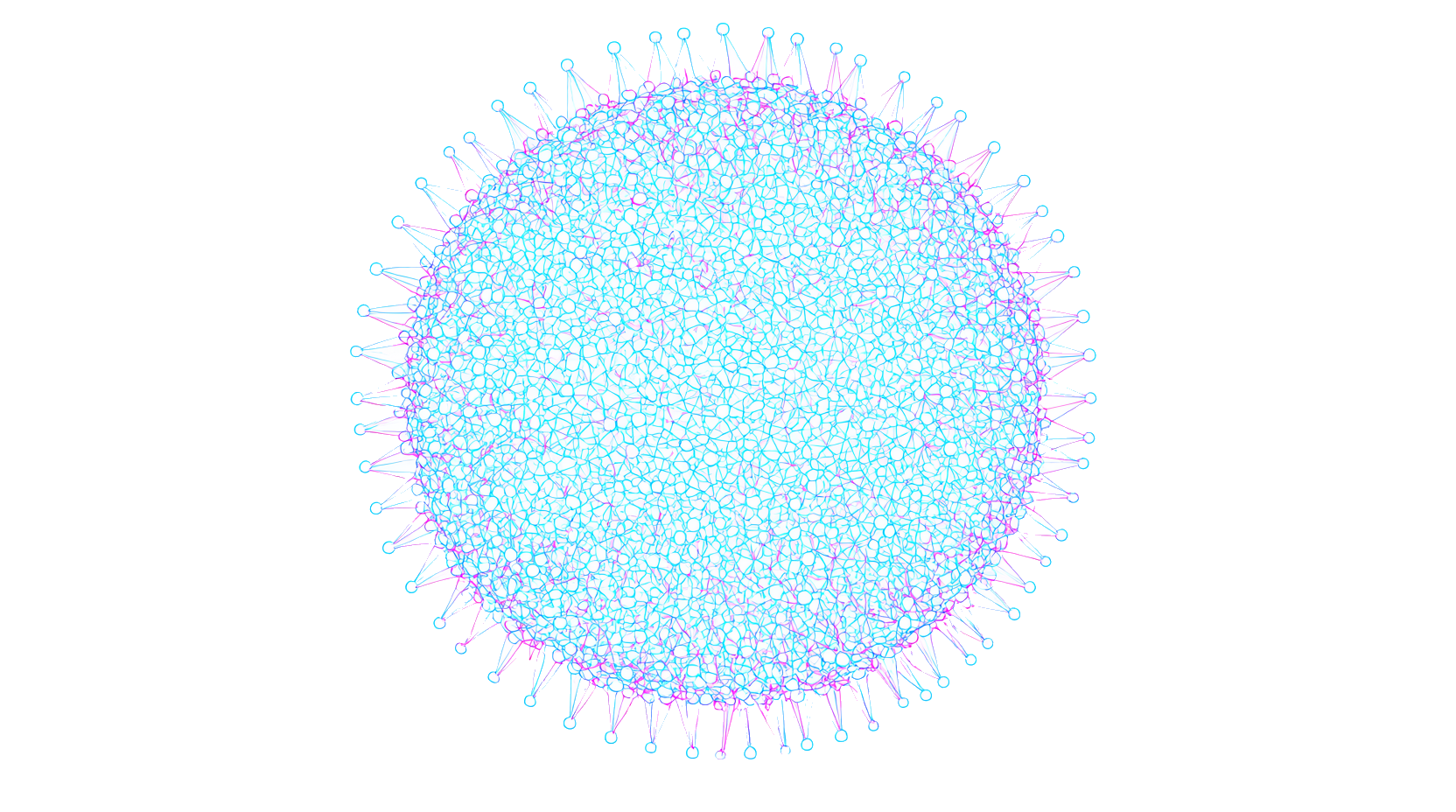
When the graph’s defects (particles, fields, radiation) are packed at maximum density, the distance between the mirror patterns inside a cluster falls below the threshold n. The Entangler, which under normal conditions works only at large distances, begins to trigger locally here — but only for enormous groups at once. This creates an effect of “premature return to zero”: the graph in the black hole’s zone begins to collapse without waiting for the Universe’s global finale.
The holographic principle here gets a natural explanation: information about the defects that have “fallen” into a black hole does not vanish — it is recoded into the structure of the cluster’s boundary nodes. For an external observer the defect is “smeared” over the surface (the event horizon), losing its individual topology. Inside the cluster, information is preserved in the most entangled, “over-fused” form.
Stimulated merging is the second key mechanism of this chapter. Entanglement is most likely between spatially close objects. In the graph model this means: the more spatial edges already connect two clusters, the higher the combinatorial weight for creating new connections between them.
Stimulated emission (the laser effect) in this model is a chain reaction: a single symmetric trigger node forces a neighboring defect to shed its asymmetry avalanche-like, copying its structure. This is not “stimulated photon emission” in the standard sense, but a topological restructuring of the local subgraph after the pattern of the trigger.
Physical correspondences:
-
Bekenstein–Hawking entropy. A black hole’s entropy is proportional to the area of the event horizon, not the volume. In the graph model: information about defects is packed onto the cluster’s boundary nodes. The number of boundary nodes determines the entropy. This is a direct consequence of the fact that the Entangler works in groups and “sees” only the surface structure of the cluster.
-
Hawking radiation. A black hole is not eternal — it slowly evaporates, emitting photons. In the graph model this is the gradual “pinching off” of the cluster’s boundary nodes by the Entangler. Each act of Hawking radiation is one step of group merging, in which a small group of boundary nodes annihilates with the external graph.
-
The information paradox. Where does the information about the matter that fell into a black hole go? In the graph model, information does not vanish — it is recoded into the topology of the boundary nodes. When the black hole evaporates, information returns to the graph through Hawking radiation, but in the most entangled, “white-noise” form. The paradox is dissolved: information is preserved, but inaccessible to a local observer.
-
Lasers and stimulated emission. In quantum electronics, a photon passing an excited atom causes the emission of a second photon with identical parameters. In the graph model: a symmetric trigger node that ends up in close proximity (a shared cluster) with a defect changes the local combinatorial weights. The defect restructures itself avalanche-like, copying the trigger’s topology. The result: two identical symmetric nodes instead of one defect.
-
The gravitational interaction of photons (Tolman–Ehrenfest–Podolsky). Two parallel photons do not attract each other gravitationally. Two opposing photons attract with double the force. In the graph model: parallel temporal arrows do not intersect and create no common subgraph. Opposing arrows intersect, creating a common interaction node. Gravity is an emergent property of the intersection of temporal edges.
Metaphors and examples
Archiver and shredder. A black hole is a cosmic archiver. It takes complex, varied files (stars, planets, light) and compresses them into one anonymous archive (mass, charge, spin). The files are not deleted — they are inside the archive, but unreadable from outside. Hawking radiation is the slow unpacking of the archive, bit by bit, over 10⁶⁷ years for a solar mass.
An avalanche in the mountains. Stimulated merging is like a snow avalanche. One small stone (a trigger), falling in the right place, triggers the collapse of an entire slope (a defect sheds its asymmetry). But the avalanche slides only where the snow is already dense and coherent (spatial closeness of nodes in the graph). On a loose, sparse slope (distant, unconnected nodes), the stone will simply fall and cause nothing.
An overcrowded warehouse. A black hole is a warehouse stuffed to the limit. The goods (defects) are packed so tightly that no aisles remain between them. Under normal conditions the Entangler walks the aisles looking for mirror pairs. In an overcrowded warehouse it does not need to walk — the pairs are already pressed against each other. Merging begins prematurely.
Key takeaways
- Black holes are zones of extreme packing of defects, where the gap between the operators is overcome locally.
- Information does not vanish — it is recoded into the cluster’s boundary nodes (the holographic principle).
- Hawking radiation is the gradual group merging of boundary nodes with the external graph.
- Stimulated merging is a chain reaction: a symmetric trigger forces a defect to copy its structure.
- Photon gravity is an emergent property of the intersection of temporal edges of the graph.
- A black hole’s entropy is proportional to the number of boundary nodes, not the volume of the cluster.